When you buy through links on our articles, Future and its syndication partners may earn a commission.

NASA is gearing up to send astronauts back toward the moon for the first time in more than 50 years with Artemis 2 — a mission that marks the next chapter in human lunar exploration — but who is Artemis?
The Artemis program is named for the Greek goddess of the moon and wilderness, and represents the agency's most ambitious human exploration campaign since the Apollo program — the series of missions that first carried astronauts to the lunar surface more than 50 years ago. Artemis 2, the program's first crewed mission, will send four astronauts on a roughly 10‑day free‑return flight around the moon and back to Earth.
Together, Artemis and Apollo form a symbolic, and literal, bridge between the past and future of human spaceflight. Unlike Apollo, which focused on short-term missions, Artemis aims to establish a sustained human presence on and around the moon. NASA also plans to explore new regions, particularly near the lunar south pole, where water ice may support long-term habitation and future missions to Mars. But in the excitement over human exploration of the moon, the meanings behind the missions' namesakes and the mythological figures that inspired them can get lost. Just who were Artemis and Apollo?
Who is Artemis?
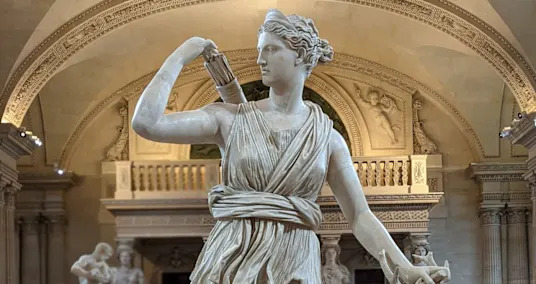
In Greek mythology, Artemis is the twin sister of Apollo and the goddess of the moon, hunting and wild places. In Roman mythology, she is known as Diana. Artemis is the daughter of Zeus, who rules over all of the other gods, and Leto, one of the goddesses of childhood.
Artemis is often portrayed as independent, fiercely protective and closely connected to nature — qualities that resonate with NASA's vision for a sustainable lunar program and mission designed to explore uncharted territory. She is often depicted carrying a bow, or sometimes a torch.
While Apollo missions landed near the moon's equator, Artemis 3 and future missions will venture farther south than any human mission before, investigating permanently shadowed craters and new lunar landscapes. The goddess's association with protection and renewal also mirrors NASA's emphasis on sustainability, international partnerships and long-term exploration.
NASA has also highlighted the symbolic importance of Artemis as a female figure, aligning with the program's goal to land the first woman on the moon.

Who is Apollo?
Apollo, Artemis's twin brother, is the Greek god of the sun, light, music and prophecy. In spaceflight history, his name is synonymous with NASA's original moon program, which flew between 1961 and 1972 and culminated in six successful lunar landings.
The Apollo missions proved that humans could travel to another world, work there and return safely — a technological and cultural achievement that defined a generation. Apollo 11's first lunar landing in 1969 remains one of the most iconic moments in human history, symbolizing exploration, ambition and ingenuity.
The pairing of Apollo and Artemis is more than poetic. In mythology, the twins balance day and night, or sun and moon. In spaceflight, Apollo represents what humanity has already accomplished, while Artemis represents what comes next.

Now, Artemis 2 prepares to carry astronauts back toward the moon. NASA is now targeting April 1 for the historic launch, although the timing will depend on technical and weather conditions.
While Apollo paved the way to the moon, the Artemis program builds on that legacy, advancing human exploration and establishing a sustainable presence beyond Earth.
latest_posts
- 1
 The Solution to Ecological Protection: Saving Nature for People in the future
 - 2It's your last chance to subscribe to Paramount+ before they raise their prices: Here's how to lock in current pricing
- 3Find the Marvels of the World with These Travels
- 4Step by step instructions to Open a Lovely Waterway Voyage Insight: Conveniences, Administrations, and Elite Offers
- 5UK, Canada, Germany, others condemn Israel's West Bank settlement plan


- Nigeria’s return to Windsor castle signals new era in UK economic partnership
- Creative Style: 10 Architects Reclassifying the Business
- Bullets in Luigi Mangione’s bag convinced police that he was UnitedHealthcare CEO killing suspect
- 4 Family SUVs: Joining Solace and Style
- Book excerpt: "Enough" by Dr. Ania Jastreboff and Oprah Winfrey
- Step by step instructions to Think about Disc Rates Across Various Banks
- Fireballs and a full moon. Here’s how to see two celestial events this week
- Virtual Route d: A Survey of \Exploring On the web Stages\ Web Administration
- Instructions to Pick the Ideal Pre-assembled Home for Your Necessities