When you buy through links on our articles, Future and its syndication partners may earn a commission.

CAPE CANAVERAL, Fla. — As NASA's giant Artemis 2 moon rocket lifted off Wednesday evening (April 1) from the Space Coast, Jews across the globe were beginning the holiday of Passover, sitting around tables for the traditional meal, called a Seder, and recounting the story of Moses and freedom from slavery in Egypt.
Here at the press site at NASA's Kennedy Space Center, hundreds of journalists showed up for the launch of Artemis 2, which is sending four astronauts on a 10-day journey around the moon. And while it has been a busy day at KSC, a few of the Jewish members of the press (myself included) paused to recognize the holiday with a mini Seder of our own.
We snacked on some Matzah, the traditional unleavened bread eaten on Passover, and remarked on our shared heritage and the convergence with a launch as important as Artemis 2.
As we stood outside a few hours before liftoff, we traded a gamut of Passover puns as Artemis 2's Space Launch System (SLS) rocket stood off in the distance. We read excerpts from an (admittedly AI-generated) Artemis edition of a Passover Hagadah, the book that outlines the order and readings of the meal. And we wondered, Why is this rocket different from all other rockets?
The question echoes the first of four essential questions that are posed during the Passover Seder, which asks, "Why is this night different from all other nights?" In the case of Artemis 2, the answer is the moon. It has been more than 50 years since NASA launched a crew of astronauts to the moon, and the SLS is the only vehicle currently in operation capable of launching people beyond low Earth orbit.
"Our ancestors fled Egypt with dough that had no time to rise. Freedom came suddenly," our Hagadah read. "You have to be ready to move when the window opens. There are no launch windows that wait for yeast."

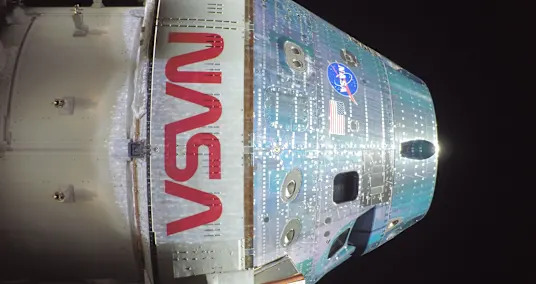
Artemis 2 is flying NASA astronauts Reid Wiseman, Victor Glover and Christina Koch, as well as Canadian astronaut Jeremy Hansen, on the first crewed mission to lunar space since the end of the Apollo program in 1972, and the first crewed mission of NASA's Artemis program. It's designed as a test flight for Orion's life support systems in deep space.
The mission is a precursor to future Artemis launches that will rehearse rendezvous and docking maneuvers with the program's lunar landers, and eventually land astronauts on the lunar surface.
Unlike Apollo, NASA is using Artemis to go back to the moon to stay. NASA plans to build a lunar base near the moon's south pole beginning in 2032, where crews can maintain a continuous presence for exploration and research, similar to how astronauts live and work aboard the International Space Station.
"On Passover, we talk about what it means to be a Jew," said Planetary Society Science Editor Asa Stahl during the Seder. "During the launch of Artemis, we talk about what it means to be human."
latest_posts
- 1
 Family-Accommodating Snow Sports Experiences
- 2Journeys That could only be described as epic: Delightful Voyage Lines All over the Planet
- 3Venice’s newest marvel is a wild, acrobatic dolphin. His refusal to leave puts him in danger
- 4Pfizer says patient dies after receiving hemophilia drug in trial
- 5Experience Sports in Dubai: A Daredevil's Aide


- Artemis II live updates: NASA's moon mission breaks Apollo record for farthest distance humans have traveled from Earth
- The Tiny Channel Island With 65 Residents That Chefs And Foodies Go Out Of Their Way To Visit
- No more attempts to free whale stranded off Germany, officials say
- The best movies to watch this holiday season: Stream 'A Christmas Story Christmas,' revisit 'The Night Before' and discover 'The Baltimorons'
- Like many holiday traditions, lighting candles and fireplaces is best done in moderation
- First SpaceX booster for upgraded Starship fails during test in Texas
- Style Narratives: A Survey of \Patterns and Styles Assessed\ Design
- Overlooked infertility care should be part of national health services, says WHO
- Europe could get 42 more days of summer by the year 2100 due to climate change