The Iran war is hitting the German economy at the worst possible time. Having only just fought its way out of a multi-year downturn, Europe's largest economy is now facing a new external shock — and the picture painted by leading researchers is one of structural exhaustion.
The country's top economic research institutes have more than halved their growth forecasts for 2026 in their Spring 2026 Joint Economic Forecast, published Wednesday.
The report, compiled twice a year on behalf of the Federal Ministry for Economic Affairs, draws on contributions from the German Institute for Economic Research (DIW Berlin), the Ifo Institute and the Kiel Institute for the World Economy, among others.
Iran war halves growth forecast
Where economists were still projecting growth of 1.3% to 1.4% last autumn, the institute now expects GDP to expand by just 0.6% this year and 0.9% in 2027.
Economic output effectively stalled in the first quarter, with the Bundesbank's March monthly report finding that real GDP likely stagnated on a seasonally adjusted basis in the first three months of the year.
"The energy price shock in the wake of the Iran war is hitting the recovery hard, but expansive fiscal policy is supporting the domestic economy and preventing a more severe downturn," said Timo Wollmershäuser, head of economic research at the ifo Institute.
Blocked shipping routes and disrupted energy markets are pushing up commodity and energy prices worldwide, with direct consequences for Germany's energy-intensive industry.
Related
-
This German village relies on renewables to avoid rising energy costs
-
Germany's first Omani LNG shipments arrive despite Middle East disruptions
Inflation on the rise
The price increases are feeding through to consumers. The institutes expect average annual inflation to reach 2.8% in 2026 and 2.9% in 2027.
The Bundesbank warns the rate could climb sharply towards 3% in the near term, driven primarily by higher fuel and heating oil prices.
Should the Strait of Hormuz — the central artery for global oil and LNG trade — remain blocked, upside risks to inflation could be greater still, directly weighing on private consumption that was supposed to anchor the domestic recovery.
While parts of the defence industry and civil engineering are benefiting from government spending, industry as a whole remains sluggish.
Exports are barely growing, held back by weak competitiveness, geopolitical uncertainty and trade policy headwinds.
The Bundesbank notes that low capacity utilisation is compounding the problem.
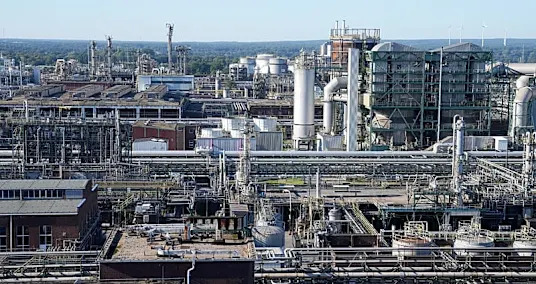
The chemical sector is bearing the sharpest pain. The Hormuz blockade is disrupting supply chains for raw materials that have no short-term substitutes.
latest_posts
- 1
 Virtual Domains d: A Survey of \Inundation and Ongoing interaction Mechanics\ Computer game
- 2'A perfect storm': Airlines cut flights and increase airfares as jet fuel price spikes
- 3Vial marked 'Polonium 210' sparks scare during German Easter egg hunt
- 4Watch Blue Origin's huge New Glenn rocket ace its epic landing on a ship at sea (video)
- 5Purchases of iPhone 17 Pro soar across Gaza amid 'limited' humanitarian aid




- Surveys of 6 Hot Savvy Beds
- Dirty soda started as a Mormon alternative to booze. Now it's everywhere.
- Nine in 10 German industrial firms expect Iran war to hit business
- Thousands of small fish defy gravity to climb Congo waterfall
- Wisconsin judge sends Slender Man attacker back to mental health institution after group home escape
- These HGTV stars made a pledge to keep their kids off smartphones. Here's how it's going.
- Astronauts on the ISS watched NASA's historic Artemis 2 launch from space
- 2026 Golden Globes live updates: Red carpet arrivals will kick off the night; Nikki Glaser set to host
- Carry Nature Inside with These Staggering Plant Decisions